.svg)

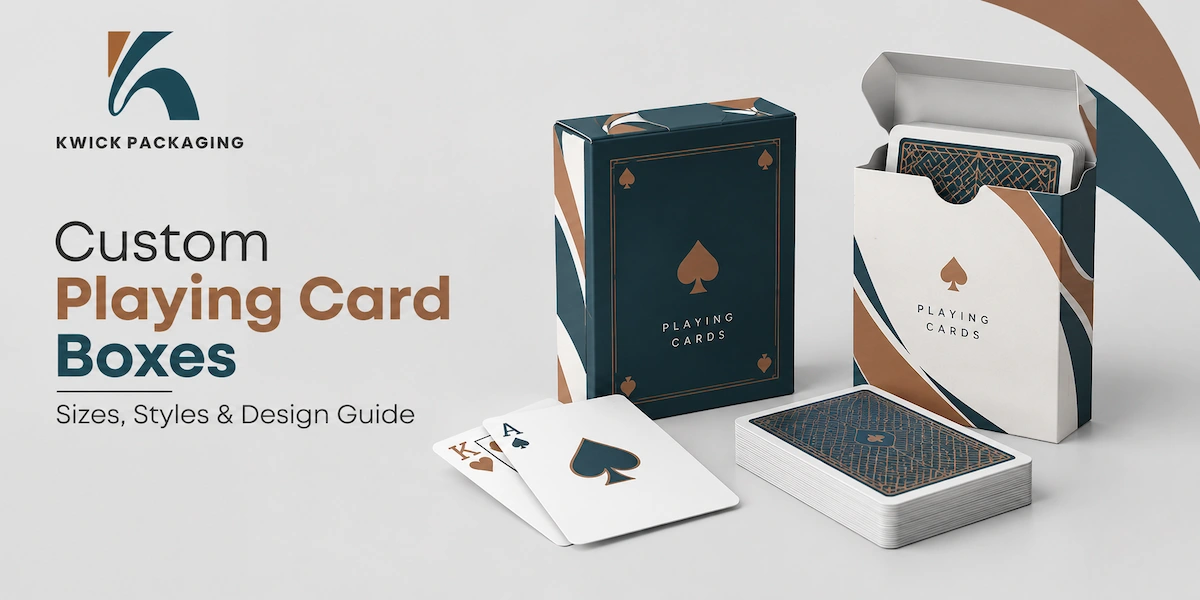
One-half of the product is a deck of cards. The box is the first thing that a buyer will see on a shelf, in a photograph or on a holiday morning under a tree. Custom Playing Card Boxes not only safeguard the deck, but they also maintain their shape after months of shuffling and convey the message you want people to associate with your brand before the first card has been dealt. Misjudge the size and the cards rattle. Find it and the entire deck is high-quality.
The Kwick Packaging guide takes you through card sizes, box styles, stock weights and printing options in simple terms and therefore you are able to order the first time confidently.
Why Does Card Size Decide Box Size?
It is not constructed around the deck, but around your box. Width and height come from the cards. The depth is the product of the number of cards and the stock thickness. A typical poker deck of 52 cards measures approximately 0.70 -0.75 inches deep. Include jokers, ad cards or stock of a heavier weight, and that number soars up. Always check your actual deck and not a chart.
What Are the Standard Playing Card Sizes?
The majority of decks are of a few accepted sizes. The following are the figures applied in the industry:
|
Card Type |
Inches |
Millimeters |
Common Use |
|---|---|---|---|
|
Poker |
2.5" × 3.5" |
63.5 × 88.9 mm |
Poker, blackjack, general play |
|
Bridge |
2.25" × 3.5" |
57.2 × 88.9 mm |
Bridge, canasta, rummy |
|
Tarot |
2.75" × 4.75" |
70 × 121 mm |
Tarot and oracle decks |
|
Mini |
1.75" × 2.5" |
44 × 63 mm |
Travel decks, promos |
|
Jumbo |
3.5" × 5.5" |
89 × 140 mm |
Magic, group play |
|
Square |
2.5" × 2.5" |
63.5 × 63.5 mm |
Specialty games |
Most orders are covered by poker size. Bridge size conserves a minimal amount of board with long runs. Tarot and jumbo are supposed to have thicker walls since the bigger panels are easier to bend. Playing Card Boxes are well-crafted to take that difference into consideration, rather than resizing a single template.
Which Box Style Fits Your Deck Best?
The traditional one is a straight tuck end. It is inexpensive, lays flat and prints well on any panel. Reverse tuck is a little cheaper to work with and is also okay to use with budget runs. Two-piece rigid boxes are better with collector decks and gift sets, as the lid slides off with a slow, smooth feel the buyer associates with luxury. The card back is displayed in window boxes. Multi-deck sets are best done with a sleeve and tray.
What Card Stock and Box Material Should You Pick?
The most common variation is 280-330 GSM and casino-grade cards are close to 300-310 GSM, in the case of the cards. In the case of the box, 14 pt to 18 pt SBS cardboard is used to work with regular decks; 400 GSM kraft is used to make brands look natural in an environmentally conscious way. Fixed solutions involve 1.5 mm to 2 mm greyboard in printed paper. Balanced box weight: on the deck weight, match the box weight and have a balanced weight on the package.
Does a Logo on the Box Really Help Sales?
Yes, and more than the majority of people think. A branded deck is a generic deck in a custom playing card box with logo. They are given out as gifts by casinos, breweries, wedding planners, and software companies since they spend years on a coffee table. Remember your mark on the front panel and the top tuck flap, as they are the most visible in store displays and unboxing videos.
Which Printing and Finish Options Add Real Value?
The finest color is produced by offset printing on large runs. Short runs of less than a thousand units are cheaper and quicker to reproduce using digital printing. Finishes have a lot of weight, beyond ink; soft-touch lamination, spot UV on the logo, gold or silver foil, and embossing all increase perceived value. Stunning printed playing card boxes tend to match a single matte base with a single shiny accent instead of having five effects simultaneously.
What Mistakes Ruin a Card Box Order?
Most reprints are due to four errors. Or forgetting bleed and leaving white slivers in the edges. Disregard depth tolerance; jam deck. Using text that is too near fold lines, where it breaks. Accepting a screen image rather than a physical one. Request a sample be printed on your actual stock before releasing the complete run. Playing Card Boxes can be easily corrected during the proofing phase and are very costly to correct afterwards.
What Drives the Price of Your Order?
The greatest lever is quantity, as setup cost is shared over the run. Next is material thickness, type of printing process, color count and finishing. Embossing and foil are charged separately. Die-cut windows take a step. When you require inexpensive Playing Card Boxes, begin with a straight tuck end, four-color digital printing and matte lamination and upgrade when your sales increase.
Final Thoughts
It all begins with a true measure of packaging and should finish with a finish that fits your brand. Choose a nail depth, a style you can afford and leave one finishing touch to do the work. Custom Playing Card Boxes that are based on these foundations are guaranteed to save your deck, elevate your shelf appearance and have customers returning each time there is a new print run.
FAQs
- What is the production time?
The average Kwick Packaging standard orders take 8 to 12 business days after proof approval.
- Should I have a die line before design?
Yes, request a die line upfront to make your printing line up with folds, flaps and bleed.
- Is it possible to have two decks in one box?
It can. Halve the depth of the deck, and then put in another 1/16" to have both decks slide out without difficulty.