.svg)


Selecting the appropriate packaging is not always easy. A lot of companies are confused about which type of box to use, either a rigid box or a corrugated box as each has its own purpose to be used.
One aims to deliver the brand presentation, and the other focuses on corrugated boxes and logistics performance. An inappropriate decision may result in additional expenses, product insufficiency, or diminished branding effectiveness.
Using the industry packaging statistics and practical application, we have observed that the packaging choices have a direct impact on customer experience, durability and sustainability targets.
Having worked on hands-on experience in the production of rigid boxes to package premium products and the handling of wholesale corrugated boxes in large quantities.
This guide dissects the major distinctions between the two to enable you to select the correct packaging with confidence.
What Is a Rigid Box?
A rigid box is a high-end packaging made of dense paperboard that maintains its shape at all times. Rigid packaging is a commonly used product presentation and a high-end unboxing experience with luxury goods including electronics and cosmetics.
Custom rigid boxes are used by many brands as they provide high protection and at the same time they are shelf-ready and can be used to reuse or stored.
The rigid packaging market is growing across the globe with over $220 billion, and still custom rigid packaging is the preferred packaging for companies that have been keen on quality, durability and brand perception.
What Is a Corrugated Box?
A corrugated box is made from fluted fiberboard layered between liner sheets to give it strength, flexibility and shock resistance.
This design enables boxes to cope with the stacking pressure and prevents products from shifting during the transportation process which is why they are popular when shipping and used in logistics.
Singlewall constructions are applied to smaller items, whereas the double-wall constructions serve as an addition of strength to heavy items. The international corrugated packaging market is over $230 billion.
So corrugated boxes shipping is still a profitable alternative in the corporation that provides an opportunity to deliver and supply the goods safely and in bulk.
-
Packaging Material Differences and Benefits
The differences between different packaging materials and their benefits are one of the crucial factors to make the right choice and solution for your product.
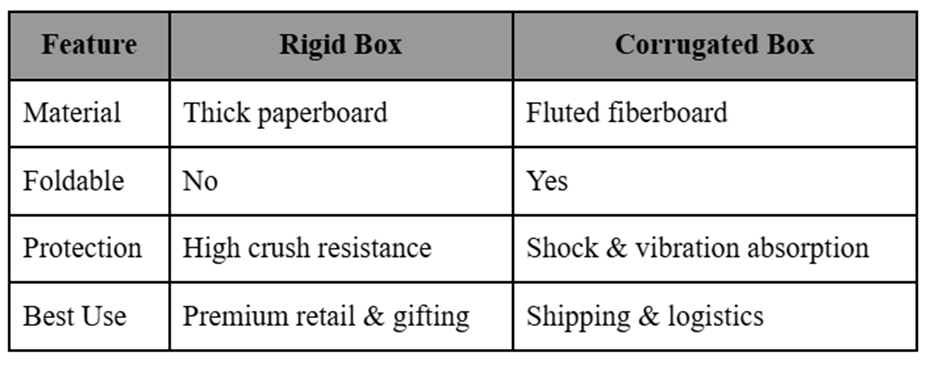
The fundamental difference is reduced to chipboard vs fluted fiberboard, with each having various forms of protection and application. Dense chipboard is the material used to make rigid packaging, which provides very good crush strength.
This strength prevents the loss of shape, resists the influence of outside forces, and contributes to high quality presentation, which is essential in the products that will have to appear perfect on shelves or during unpacking.
Corrugated packaging, on the other hand incorporates the use of fluted fiberboard, which brings in the element of flexibility and air pockets that cushion against impact.
This makes the corrugated packing very efficient in absorbing shock and vibration particularly during transportation.
Both materials are good in terms of performance in both aspects, which include good durability and protection to paper in packaging of the products, but in distinct ways.
Where rigid box emphasizes structure and the appearance of the material, corrugated emphasises on the ease of movement and safety in transit.
-
Rigid Box vs Corrugated Box Comparison
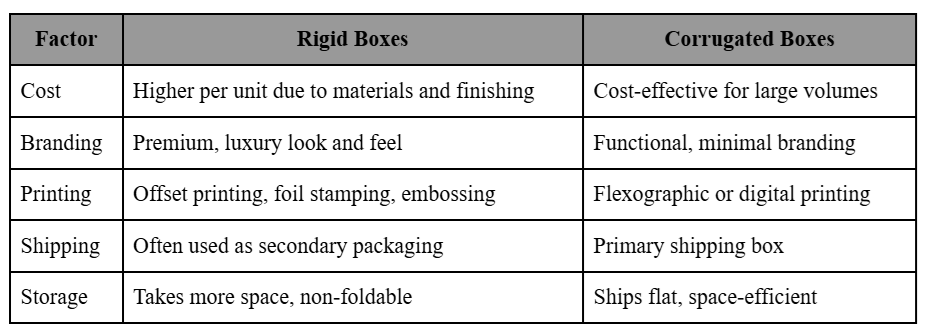
This rigid box vs corrugated box comparison shows the performances of these two types of packaging in the real-world of business, particularly in terms of cost, branding, and logistics.
Although both variants are highly durable and protect the packaging of the product, they are optimized on a completely different basis for example presentation and efficiency.
These differences are captured in industry data in terms of market. Commodities within the international corrugated boxes industry and the rigid packaging market were valued at above $230 and $220 billion respectively.
As e-commerce and shipping demand drove growth and the high-end and luxury products drove the rigid packaging sector.
This is a very clear indication that corrugated box are prevailing in high volume logistics, and rigid packaging is increasing whereby brand value and customer experience warrant higher costs.
-
Cost & Shipping Efficiency
In terms of cost and shipping efficiency of packaging boxes, the corrugated solutions evidently prevail in the logistics of large scale. The use of corrugated boxes for shipping is prevalent since the boxes are lightweight.
Can be shipped flat and minimize transportation and storage expenses thus making them an ideal packaging in high volume distribution.
The corrugated packaging market is estimated at $234 billion globally in 2024 and e-commerce packaging is estimated at $53.4 billion, due to the rapid expansion of e-commerce.
Rigid packaging on the other hand is more expensive as it uses thicker material, hand assembling and high quality finishing.
-
Custom Packaging & Branding Experience
An excellent custom packaging and branding experience will improve the perception of a product by customers. Premium printing effects such as foil stamping, embossing and UV finish are available on custom rigid boxes and help increase the impact of unboxing.
Properly designed boxes affect brand confidence and perceived value like the Apple type packaging where the structure and simplicity are used to create a sophisticated, memorable experience.
-
Sustainability & Recycling
Sustainability is becoming a major factor in the packaging decision. The corrugated boxes are commonly recycled, and the recycling rate of the same is about 71-76% in the year 2023.
It is also possible to recycle a rigid box made of paperboard but the possibilities of recycling are limited by coatings and laminations. Sustainable packaging relies upon intelligent material selection and the use of a bare minimum finish.
When Should You Choose Which?
Choose Rigid Packaging When
- Packaging luxury or high-value products
- Creating retail displays or gift packaging
- Using packaging as long-term or rigid storage boxes
Choose Corrugated Packaging When
- Managing corrugated boxes shipping for e-commerce
- Handling bulk transport or warehousing
- Prioritizing cost control and scalability
Such straightforward, sincere suggestions are beneficial in ensuring businesses make sound choices based on real needs and not accounts of trendiness.
Conclusion
It all boils down to purpose when selecting the appropriate custom packaging boxes. While rigid packaging makes things look better and helps with branding and corrugated packaging makes shipping easier and cheaper.
The best choice is one that works with your budget your goods and what your customers want.
Read to Know! How Many Boxes Do I Need to Move?