.svg)

Print on demand (POD) is a business model that is popular due to its low start up cost, lack of inventory risk, and customization. But is it truly profitable?
The response is yes, Printing on demand is able to produce healthy margins with smart strategies, efficient operations and the appropriate niche. Definitely, as a responsible printing company we ensure your brand makes it a win.
The Elegance of Substrates with Screen Printing
The substrate is one of the most important bases of profit making screen printing. Basically, it is the material on which the ink is deposited during printing.
Screen printing (sometimes known as silk printing) could be done on paper, cloth, plastic or other surfaces. This is because the nature of the substrate influences the adhesiveness of the ink.
It also influences the strength of the print, and the final colors which look bright. An example of this is that a porous material such as untreated cotton will take up ink in a different fashion to a coated synthetic or plastic.
When the substrate is excessively smooth or non-porous, then the standard inks might not bond well, and this can either lead to reduced quality of the print or even peeling.
Optimizing substrate ink combination reduces wastage, enhances stability of print, and eliminates expensive reprints. This is a must in the profitability less mistakes imply less expenditures per unit.
Computer to screen (CST) machines, which are more advanced are also useful in accelerating the creation of screens and minimizing the amount of material wasted, translating to lower cost of operations.
With a good comprehension of substrates, a POD business (or any other printing company) can provide higher quality screen prints, will be able to charge more on high-end work, and still maintain a lean production.
How Does Screen Printing Work?
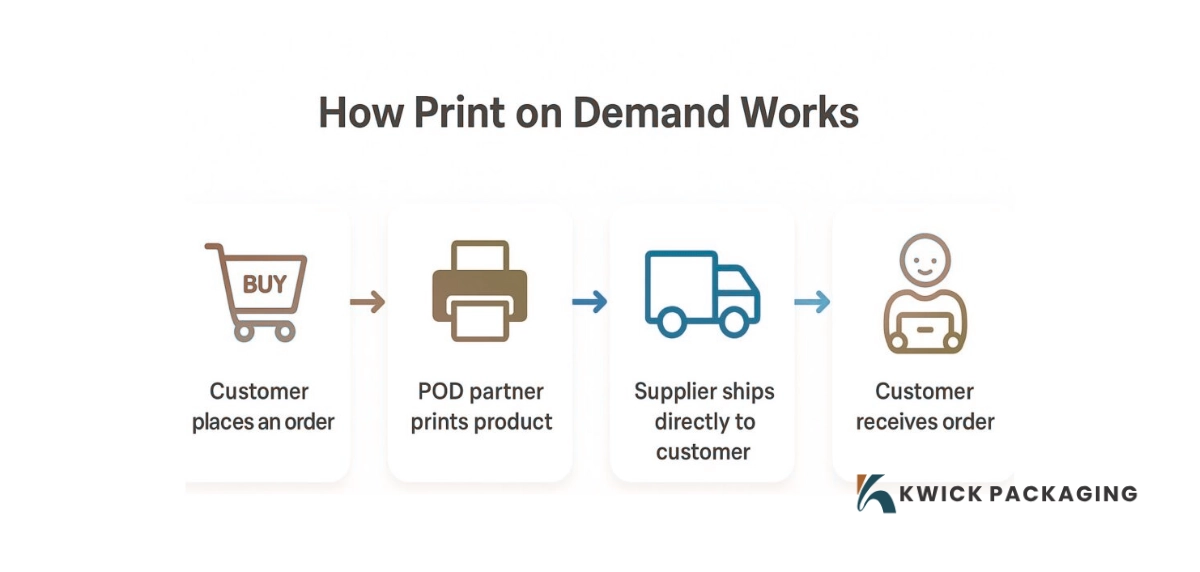
Screen printing (silk printing) is an ancient yet very strong technique in the print industry. The method is as follows: a mesh screen is first made ready with a stencil - in the form of the design parts of the mesh are covered in.
An ink is then forced through the mesh (with a squeegee) onto the substrate. This is followed by curing the printed substrate (typically by heat or UV, depending on the type of ink).
It also scales very well: once a screen has been created, the screen can be reused many times and so the per-unit costs are reduced with larger run sizes.
However, it is fairly costly to put up (creating the screen), thus screen printing is particularly lucrative when dealing with medium or high-quantity orders or unique items (such as branded merchandise, clothes, or custom packaging).
Through integrating screen printing with your POD business establishment, you would be able to sell high quality substrates with reusable designs at a premium price with a higher charge on color fidelity, longevity, and volume cuts.
What Are Managed Printing Services?
Managed custom printing services (MPS) are printing services that are outsourced, that is, a printing company controls the end to end printing requirement of a client.
This implies that you look after the whole process design, materials, production, storage, fulfillment and even delivery. Managed printing provides a solution to the business that would not want to establish its own solid print infrastructure.
Future Market Insights reports that the world print on demand market is experiencing a booming trend due to the e-commerce, personalization trends, and the need to attain low-inventory models.
The print on demand market sector expects a growth ratio from USD 11.0 billion in 2025 to USD 89.4 billion by 2035, with a compound annual growth ratio of 23.3%.
In the case of businesses querying print on demand, MPS can increase profitability in two aspects. To start with, you can have economies of scale by centralizing the production.
Thus purchasing substrates, ink, and other materials in raw quantities makes the price per unit lower.
Secondly, MPS is often associated with analytics. You monitor the popular designs, which SKUs sell more quickly and the best time to order inventory or to reprint.
You become able to transfer some of these operational efficiencies to your clients. While being still able to have healthy margins.
Providing services under management control will give value to your customers. It reduces hassle, improves professionalism) and yet maintains your print on order operations lean and profitable.
How to Cut out Custom Cases to Be 3D Printed?
When your Print on demand business involves 3D printing, a great service to be offered is cut-outs or engravings on 3D printed cases customized. This is how it can be done: first, you/your client must design the case in 3D modeling software (such as CAD).
Next, a case is printed on a 3D printer with a high enough degree of precision that cut-outs or engraved shapes (logos, text, patterns) can be made.
Such tailor made cut outs create value and uniqueness. To illustrate, a case with an accurately cut logo or a decorative pattern on it is likely to fetch a higher price than an ordinary case.
The design is created through software. So, its easily customizable or tailored to the order making it ideally suited to print-on-demand.
How We Help Businesses Through Print on Demand Services?
A dedicated printing company (such as Kwick Packaging) is very valuable to enterprises that consider print-on-demand. Here's how:
Scalability
We cater each order with precision and commitment. We accept small print on demand businesses and expand to larger managed printing deals. We know to deal with the needs of a business as it expands.
You become a trusted partner that can help businesses reduce their risk. It will maximize product quality and access the increasing demand of personalized and on-demand products.
How Much Is a 3D Printer?
When you are thinking of adding 3D printing features, you likely ask yourself the following question: just how expensive is a 3D printer? It is of a wide variety, of quality and size.
Industry statistics show that a combination of consumer-grade desktop three-dimensional printers (such as many FDM printers) can be as cheap as less than 1,000 dollars.
While an industrial system can be tens or even hundreds of thousands of dollars. In the case of a POD business, desktop or prosumer printers will be of value to most startups in terms of price and features.
As you grow and have a high end customer base, you may invest in more sophisticated devices. Yet lower unit cost can easily justify this as the demand increases.
How to Print Two Sided on a Printer?
The double sided printing is even more typical of the traditional flat-bed or sheet fed printers (as opposed to the 3D). This is how it works in that context, first you put the substrate (paper, cardstock, etc.) into the printer.
When one side has been printed, the machine reverses or re-feeds the substrate to allow the second side to be printed.
It can also be done in screen printing, where the printing may be done on both sides. You print the first side, allow it to dry, re-register it (align it perfectly) and print the other side.
It is more difficult to install and needs to be carefully aligned, although it can increase the value of the product twice. E.g., you might provide two sided postcards, packaging, or 2D merchandise - and sell at a higher rate because of the higher cost of material and labor.
That could be a significant margin expansion in a POD model: the items that are of both sides are premium and worth higher prices.
How Do We Use a 3D Printer?
This is how our 3D printer is being used in a Print on demand friendly manner by us (as a printing company):
Prototype First
3D printing prototype product designs fast - phone cases, custom tools or small figurines.
On-Demand Production
When a customer makes an order, we print what he/she needs, nothing more, no waste, no stockpiles.
Customization
We use 3D modeling software in order to enable the customer to customize what they want (cut-outs, text, unique shapes, etc.).
Post Processing
Once they are printed, we polish the works (sanding, painting, finishing) to appear professional and polished.
Quality Control
All printed items are checked; the defects are corrected, and only good products are shipped. This strategy helps us to sustain flexible and responsive POD business with the help of our 3D printing activity. It also guarantees stable quality and efficiency.
Final Thoughts
And thus, does print-on-demand make a profit? Absolutely, when done right. The trick is that it is possible to mix the legacy methods, such as screen printing (with careful choice of substrates).
In contemporary you can go for; agile ones, such as 3D printing and managed services. The POD market is experiencing the rapidly increasing demand of personalized products. It causes efficient production, and minimal waste, so that further growth can be predicted.
With a combination of technical knowledge, personalization, and operational effectiveness, a printing organization like ours can make businesses grow. While it minimises risk, and increases value.
Print on demand is not only feasible. In fact it is an intuitively smart and visionary business model. So cost structure, quality and customer experience are handled in an appropriate way.
Kwick Packaging helps businesses with print on demand and bulk orders using the best color techniques and printing mechanisms.
Read to Know! How to Design Unique Vape Packaging?