.svg)

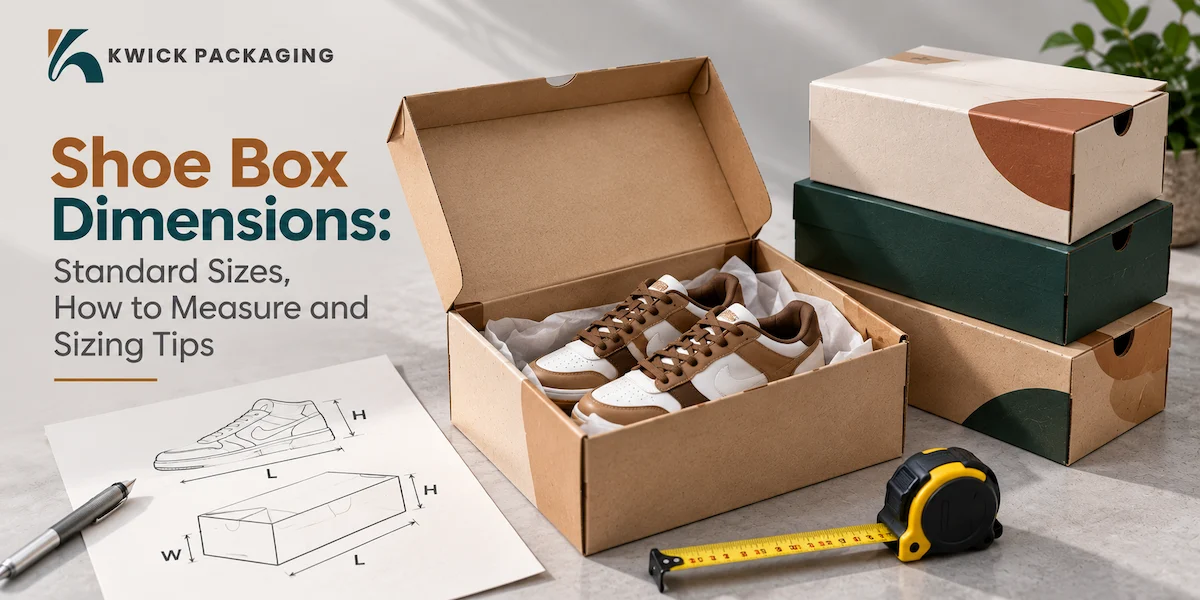
Have you ever had a box that you ordered to have your shoes in, and it was too tight, or it was too loose so that the shoes would slide about? The correct shoe box dimensions will help you avoid that headache. This guide will include typical men's, women's and kids' sizes, easy steps to measure and tips to choose the proper fit to ship.
Standard Shoe Box Size:
The dimensions of a shoe box depending on the shoe.
|
Type |
Inches (L x W x H) |
Centimeters (L x W x H) |
|---|---|---|
|
Men's |
13.5–14.5 x 8.5–10 x 4.5–5 |
34–37 x 22–25 x 11–13 |
|
Women's |
12.5–13.5 x 7.5–8.5 x 4–4.5 |
32–34 x 19–22 x 10–11 |
|
Kids' |
8–10 x 5.5–6.5 x 3–3.5 |
20–25 x 14–17 x 8–9 |
These are approximate, not hard and fast. The sizes vary based on the brand, style and the shoe size so use the table as a guide.
How Do You Measure a Shoe Box?
All you need is flat table and ruler.
- Length: measure between one end and the other the longest side.
- Width: figure out the short side of the front.
- Height: this is measured between the bottom and the top edge. Others refer to this as depth.
- Always write the numbers in the order length x width x height.
Fit the box inside or outside the box (ship) or shelf space. The two are often confused.
How Much Extra Room Does a Shoe Need?
The shoe box dimensions begin with the shoe and not the box. The height of the shoe, width of the widest part and length of the heel-to-toe. Then add to each number nearly half an inch. That tiny space allows the shoe to lay flat without being bumped or folded.
How Do Shoe Types Change the Size?
Not all shoes fit the same way. And this is what varies:
- There should be increased heel height and length of the heel and toe.
- Boots require a considerably taller and longer box, and are frequently long in excess of 14 inches.
- Most sneakers will fit in a standard box, but thicker designs might require additional height.
- Shoes of kids also differ significantly with the increase in their feet, hence measure a real sample.
What Size Box Do You Need for Shipping?
To ship, you can use a slightly larger right shoe box size than the retail box: you can add paper or a mailer around it. Most of the sellers leave 1 to 2 inches of additional space on either side to pad. Do not go too big, though. Frequently, carriers have a pricing system that is dependent on the size of the box along with weight, resulting in a larger box being more expensive.
Why Does Getting the Size Right Matter?
Improper shoe box dimensions are real money. An oversized box causes the shoes to slide and be scuffed during transit. A small box squashes the toes, bends the heels and creates marks on the shoe. Both result in returns and dissatisfied consumers. A fitting bag keeps the product safe and unboxing is a neat and careful experience.
What Mistakes Should You Avoid?
Do not use a chart of the shoe box size dimensions. Averages are depicted in charts and your shoe can be longer, wider or taller. And omit these slip-ups:
- Forgetting the thickness of the box walls
- Measuring out that you meant in.
- Ignoring the space that inserts or tissue paper take up
- Placing an order in large quantities before trying a single sample.
When Should You Go Custom?
Many shoes work on stock sizes, and there are some items that require additional stock. Luxury sneakers, boots and heels can require shoe box dimensions to be created to fit the precise shoe, with inserts to keep it in place. In Kwick Packaging, we would recommend ordering one sample and then when you are sure that it fits the shoe, then you can proceed to start the real production.
Final Thoughts: Ready to Find the Right Fit?
There are three things that contribute to the right shoe box dimension, which are measuring the shoe, providing some space and testing a sample. And your shoes will arrive safely and look great with those steps.
FAQs
- What is the measurement to select the correct box?
Record the distance between heel and toe, the widest part and the tallest part. Then add half an inch to each number.
- What size shipping box should it be?
Pad with about 1-2 inches of space on each side. The excessive wastage of space may increase your freight bill.
- What is the box for boots?
Boots require a taller and longer box and many require 14 inches or longer. Measure the real pair before ordering.
- Which material is suitable to use in shoe boxes?
Folding carton or corrugated board is good for ordinary shoes. Luxury shoes boxes require additional protection and that is why rigid boxes are used.
- Are the shoes of kids of one box-size?
No, The feet of kids change rapidly and thus sizes do. Measure a real sample and select a box based on that.