.svg)

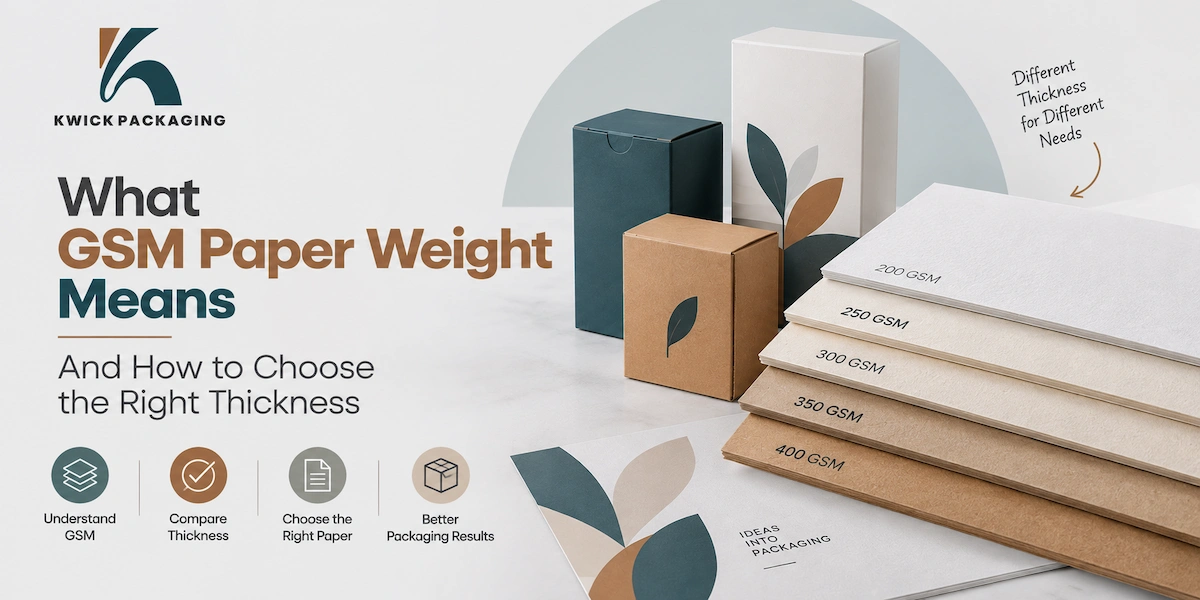
If you have ever ordered business cards, boxes or wrapping tissue and were surprised to find it was so thin or thick, it is probably due to GSM. GSM paper weight informs you of the weight of a sheet of paper per square meter and it is the one number that determines the stability, high quality or poor quality of your printed material. In this manual, GSM is not a guess total but a breakdown of real industry data to ensure you order the correct paper the first time.
What Does GSM Actually Mean?
GSM is an abbreviation of grams/square meter. To quantify it, printers cut a sheet, and reduced it to a perfect square meter or one square meter and weigh the cut piece on a scale. A sheet of 80 grams is 80 GSM and a sheet of 300 grams is 300 GSM. It is not about size or shape but the amount of material that is contained within that one square meter of paper.
How GSM Affects Paper Thickness Guide Ranges
A paper thickness guide can only be helpful when you realize that GSM does not directly measure thickness, but rather weight; the two tend to move in the same direction. Normal copy paper is positioned at 75-90 GSM. Letterheads and brochures have a range of 100 to 150 GSM. The middle range of 200 to 300 GSM is occupied by postcards and light cardstock, and high-end boxes and solid packaging are frequent above 300 GSM. Thick paper is harder to tear, contains ink better and is more valuable in hand.
Why the GSM to Lbs Conversion Isn't One Simple Number
Numerous guides say that there is one GSM to lbs conversion rate, but it is not so. Paper weight in the US is calculated in pounds; 500 sheets of base sheet size and the base size varies according to the type of paper. The various base sizes of text paper, cover paper, bond paper, and index paper mean that 80 lb text paper and 80 lb cover paper are by no means the same weight. According to industry conversion charts, 80 lb text paper will yield approximately 118 GSM and 80 lb cover paper will yield approximately 216 GSM, which is almost twice. Always verify that a lb rating is either text or cover stock when ordering.
Choosing the Right Cardstock GSM for Packaging
The choice of the appropriate cardstock GSM is based on the type of paper required to survive. Greeting cards, hang tags and inserts that do not require heavy weight work on light cardstock of between 250 and 300 GSM. When your product is delicate you should not go too low on GSM because you can expect squashed corners and an inexpensive initial impression, despite high-quality printing.
What Is Custom Tissue Paper Printing and Which GSM Works Best?
A lighter category of paper is used in custom tissue paper printing as compared to boxes or cards, usually 17-30 GSM. This paper must remain soft and foldable to enable it to cover goods without tearing along the folds. To transform a basic wrapping into a branded unboxing experience, brands print logos, patterns or brand colors directly onto the tissue. Less GSM wraps around the oddly-shaped objects more effectively, whereas slightly heavier tissue in the upper range contains ink and folds better to be used in retail.
GSM in Fabric Weight: A Quick Comparison
GSM is also used in fabric weight, but ranges appear dissimilar to paper. Summer clothing made out of lightweight fabric ranges between 30 to 150 GSM, t-shirt jersey is average, which is in the range of 150 to 250 GSM; and heavyweight fabrics such as denim or canvas are in the range of 250 and above. The same applies to paper: the denser and heavier the material, the higher the GSM and the less wearable but the less breathable, it feels.
How Does GSM Affect Print Quality and Machine Performance?
Light paper tends to wrinkle, bleed or jam printing machines. The paper that is too thick to be pressed in a normal press may break when it is folded or may not feed at all. Aligning GSM with your design and your process is a way to save your print run from expensive reprints and wastage.
How Kwick Packaging Helps You Choose the Right GSM
At Kwick Packaging, we assist companies in aligning GSM with the actual work, rather than a graph. Gift wrapping, tags and inserts, rigid boxes: Depending on the weight of your product, shipping requirements, and print design, our staff reviews the specifications and suggests a specific thickness. This prevents the usual error of ordering paper that appears okay on the computer but fails miserably when it is printed and packed.
Final Thoughts on Picking the Right GSM
Getting GSM right does not mean choosing the heaviest possible. It is all about the paper to match the job, be it a soft tissue wrap, a durable retail box, or a high-end business card. Knowing the GSM paper weight lets you control not only the cost and durability but also the feel of your brand in the hands of a customer, and it allows you to avoid the errors where it takes a lot of money to correct once the paper is printed.
FAQs
- Does increased GSM necessarily make better packaging?
Not always. Very high GSM may be more difficult to fold and more costly to transport; thus, it must be appropriate to the weight of your product and your actual protection requirements.
- Which type of GSM is suitable for custom tissue paper?
The printing of most custom tissue papers is done with 17 to 30 GSM that is soft enough to package products yet capable of retaining printed designs.
- What is the conversion of cover paper 80 lb to GSM?
Approximately, 80 lb cover paper is 216 GSM, but always verify the pound rating is text or cover stock as they have different base sizes.
- What GSM is regular printer paper?
Common office and copy paper is typically between 75 and 90 GSM, and is light enough to print and manipulate on a daily basis.
- Is GSM a measure of thickness or weight?
GSM does not directly measure thickness, but measures weight per square meter, although heavier paper tends to be thicker, too.
- Which GSM should I use on the rigid gift boxes?
Hardboard gift boxes normally require paperboard of 300 GSM or above to ensure that the box keeps its shape and prevents the goods inside it from being damaged during shipping and handling.